Crewed yacht charter etiquette comes down to one idea: make the crew’s week easy and they will make yours great. Everything below is how.
A crewed yacht is not a hotel. The people looking after you also live aboard, and the week is something you make together. That is why the small things matter more here than anywhere else you stay: the preference sheet before you arrive, the shoes at the passerelle, the heads-up before a late night.
It also means there are fewer rules than people fear. Nobody expects you to know the deck fittings or to tip in a particular envelope. What the crew notice is whether you told them what you like, and whether you let them do what they are good at.
This guide covers what the other ones skip: how late service really runs, what happens at night in a shared anchorage, the smoking rule and why the owner sets it, what a tip actually is, and what a captain would tell you if you asked.
Broker insight
As captain, the easiest weeks were never the quiet guests. They were the ones who told us what they liked on the first morning. After that we could plan everything around them.
 Daniel Asmus
Owner, Charter Broker, Active CYBA Member, IYBA, ECPY
Daniel Asmus
Owner, Charter Broker, Active CYBA Member, IYBA, ECPY
Before you board: the preference sheet is the crew’s only briefing
The preference sheet is the crew’s only briefing on you before you arrive. It decides what goes in the galley, where the boat goes, and how sociable the crew are.
Ask for the yacht’s own sheet and have every guest fill in their part. One sheet with everyone on it works best, because the person who books rarely knows every allergy in the group.
What to put on it:
- Food and drink in detail. Allergies, the wine you drink, how you take your coffee.
- Passport details for every guest. The captain needs them for cruising permits. A missing one can cost 2 hours at the dock on boarding day.
- The places you want to see, so the crew can plan around the weather.
- The mood you want. Crew involved and sociable, or serving and stepping back.
Anything special, a fishing day or a formal dinner for 8, is a call with your broker rather than a line on a form. Here is how the whole charter process works.
Before any of that, what to have ready before you talk to a broker gets the first message right.
Shoes, and the two other things about the boat itself
Shoes come off at the passerelle. There is a basket for them at the top of the gangway. Teak and deck cushions mark easily, and bare feet grip better on a moving boat.
For the deck, bring soft, clean, non-marking soles. Heels go in the bag for dinner ashore. Our Greek team’s guide to what to pack for a yacht charter covers the rest.
The two other things:
- Luggage depends on the yacht. A large motor yacht has walk-in wardrobes, and hard cases are fine. On a catamaran under about 60 feet, cabin storage is tight and soft bags stow better. Ask your broker which you have.
- Where you are welcome. Every guest area is yours. Crew cabins and the crew mess are the crew’s own, the bridge is by the captain’s invitation, and the galley is the chef’s: ask, and you will get a tour between services.

What the crew’s day actually looks like, and when service ends
Service runs as long as your day does. The people who lay breakfast pour the last drink. A 55-foot catamaran for 8 guests runs on 2 crew; a 120-foot motor yacht for 11 runs on 7. That headcount is what decides how a late night lands.
- Morning: breakfast is served when you get up, and the boat moves to the next bay while you eat.
- Daytime: you see less of the crew than you expect. They are cleaning, doing laundry and prepping dinner. Anything you want is one request away.
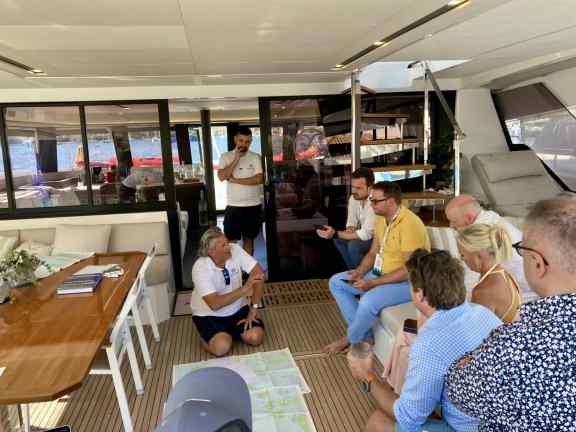
- Evening: it ends when you say it does. One of our brokers watched a captain on a Croatia fam trip at his post from morning until 2am.
A late night buys a later start, not a tired crew. Crew rest hours are regulated on a commercially run yacht, so announce a big night in the afternoon and the captain shifts the morning around it. Two big nights in a row on a 2-person crew is the one to talk about.
How at home you can be:
- The guest fridge is yours at midnight. Ask on day one which one it is.
- Leave your plate. The stew would rather you watched the sunset.
- A 6am coffee you make yourself is fine. Ask how the machine works on day one.
- The crew eat separately, on their own clock. Expect a polite no to a dinner invitation, and ask again for a drink on the last night.
Changing the plan: ask the captain, not the deckhand
You can change the plan, and the captain is the person who says how. The itinerary you agreed with your broker is a wish list. Wind, swell, berths and the captain’s knowledge of the coast turn it into the week.
The hardest brief a captain gets is a fixed itinerary demanded stop by stop. Put the places you care about on the sheet and let the crew build the days around the weather.
The 3 timings that make a change easy:
- The route: ask the captain, ideally the evening before. The deckhand cannot say yes to a new anchorage. A port night swapped for a quiet bay is easy; the reverse, in a popular harbor in August, may not be.
- The toys: say in the morning what you want in the afternoon. Rigging can take the deck crew up to an hour.
- A problem: say it that day. Crews would rather fix it on the spot than read about it in a review. A wrong duvet gets swapped the same afternoon.
Nights: music, parties, and the boat anchored next to you
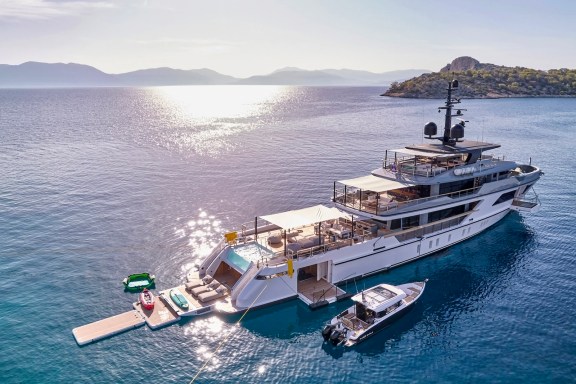
The first decision is the boat. One motor yacht we list has a DJ deck and a disco ball. One catamaran is, in the words of the broker who reviewed her, quiet generators, no pets, not a party boat. Tell us which week you want and the shortlist changes.
Sound carries over water. At a shared anchorage the convention is simple: music on deck while the bay is awake, then inside or ashore late in the evening. Marinas may post quiet hours, and the captain knows them.
Better still, ask the captain in the afternoon for a bay with nobody in it. Reading whether a group wants the party beach or the empty bay is a crew’s specialty. Say it out loud.
Nights ashore are easy. The tender runs you to the bar and back. Agree the pickup time with the captain, because the deckhand who collects you at 2 is rigging the paddleboards at 8.
The boat anchored next to you is the flip side. Peak-season harbors in Croatia fill with bareboats and party boats. If quiet matters, dine in town and sleep at anchor outside it.
Smoking, vaping and cigars
Smoking is never allowed inside a charter yacht. Outside, the rule is the owner’s, and the captain enforces it. The rest, in the order the captain will give them:
- On some yachts the aft deck or swim platform, downwind, is fine. On others there is no smoking or vaping anywhere aboard.
- Vaping counts as smoking wherever the rule is strict.
- Never in the tender. It is a fuel tank with seats.
- Butts go in the lidded ashtray the crew hand you, never over the side.
- Cigars are welcome on the right boat. Two yachts we have been aboard keep a humidor for a whiskey and a cigar on the back deck.
- Cannabis stays at home. It is illegal on the water almost everywhere we charter, and a find can mean the yacht seized and the captain’s license gone.
Why owners set the rule: smoke settles into upholstery, an ember on teak is a fire on a boat carrying fuel, and a yacht that smells of tobacco is harder to charter and to sell.
So tell your broker. If you smoke, we shortlist yachts where the aft deck is yours. If you want a smoke-free boat and crew, the central agent puts it in writing.
Kids, guests of guests, and pets
Children are welcome, and the crews who like them really like them. Crews have told us on camera that they snorkel with the kids so the parents get the reef, run movie nights, and offer to babysit after dinner. Ask us for a crew like that.
Charter contracts make children the adults’ responsibility, not the crew’s. A nanny is yours to bring, and counts as a guest unless the yacht has a nanny cabin. Some do. The chef can run 2 sittings, children at 6 and adults at 9, if it is on the sheet.
The ceiling is 12 guests on almost every charter yacht, and a 2-year-old counts. Above 12 it is a second boat, or one of the few yachts licensed for more.
Guests of guests are fine with the captain’s yes and a name on the list, because the port and the yacht’s license count heads. One Sunreef we work with sleeps 8, allows 10 for drinks at anchor, and keeps the toys for registered guests.
Pets come down to the owner. Some say yes with a cleaning fee from the APA, sometimes a deposit, and a photo and the breed first. Say so at the first inquiry, because the dog decides the shortlist.
Tipping: how much, when, and on all-inclusive boats
A tip is always at your discretion. The MYBA charter agreement your captain signs does not require one, it is never charged up front, and no one will ask you for it. What follows is custom, not contract.
The custom is 5 to 15 percent of the base charter fee in the Mediterranean and 15 to 20 percent in the Caribbean, handed to the captain on the last day and shared equally across the crew.
In the Mediterranean, 5 percent says a decent week, 10 a good one and 15 a great one. In the Caribbean, 15 is the usual floor, because crews there work on the American model.
The gap is one of several that run between the two oceans, and we set them side by side in our guide to choosing between the Caribbean and the Mediterranean.
- On what: the base charter fee, never the VAT or the APA. A EUR 100,000 Mediterranean week means EUR 5,000 to 15,000.
- Who: one amount to the captain, split equally, including the deckhand you saw least.
- When: the last evening or the morning you leave, once the APA statement is settled.
- How: cash, a transfer arranged before you board, or unspent APA redirected to the crew on your instruction.
On all-inclusive boats the custom is the same and the tip is still separate. The rate covers boat, crew, meals, bar, fuel and moorings; the tip comes from you, calculated on the all-inclusive fee. A $40,000 Caribbean week means $6,000 to $8,000. Our guide to tipping the crew in the BVI has worked examples.
In Greece, where all-inclusive is rare, one or two offers we have seen write the gratuity into the rate. If the offer says so in writing, it is included. If not, it is not.
The crew work through their own Christmas, and our guide to Christmas and New Year yacht charters covers what they do on the day and what the tip looks like that week.
Broker insight
We tell our clients that the customary tip in the Caribbean is 15 to 20 percent of the charter rate and is based on service and overall experience. In the end we cannot control how much a client tips, but it is our job to make sure they know what is expected. Tip is earned and cannot be expected, although it is customary.
 Alex Hailwax
Charter Broker, former charter captain
Alex Hailwax
Charter Broker, former charter captain
What genuinely annoys a captain
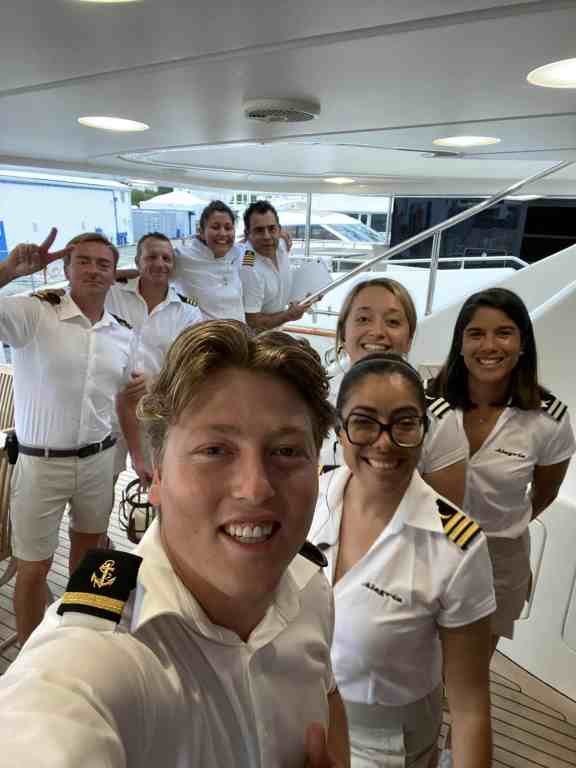
The captains and crew who have answered this gave smaller answers than you would think:
- “We are very low maintenance.” One returning BVI crew said the guests who open with that line need the most. Say what you like instead.
- Watching every move on day one. A Croatian captain’s version: leave the crew a little space and they will figure you out. Within a day or two your coffee arrives the way you take it.
- Saving the problem for the review. The crew want to hear it that afternoon, and the good feedback too.
- An itinerary demanded by the hour. Give them the 3 places that matter and let them earn the rest.
- A preference sheet that arrives the week before, with passports missing. Send it once the second payment is made, so the crew can provision and file the permits.
What makes a captain’s week is the mirror image: one sheet with everyone on it, a heads-up before a late night, feedback on the day, and a group that lets the crew do what they are good at.
Planning your first crewed week, or your first on a bigger yacht? Tell us the week you have in mind. We know which crews love children, which boats allow a cigar on the aft deck, and which captains will find you an anchorage with nobody in it.
People also ask
How much should you tip the crew on a crewed yacht charter?
It is always at your discretion; the MYBA agreement does not require a tip. The custom is 5 to 15 percent of the base charter fee in the Mediterranean and 15 to 20 percent in the Caribbean, handed to the captain at the end of the week and shared equally across the crew. Tip on the base fee, not the APA or VAT. On an all-inclusive boat, calculate it on the all-inclusive fee.
Do you wear shoes on a crewed yacht charter?
Not on deck. Shoes go in a basket at the top of the passerelle, and aboard you go barefoot or in soft, clean, non-marking soles.
Bring shoes for dinner ashore and for hot marina docks if you want them. Heels stay in the bag until the tender.
Can you smoke on a yacht charter?
Never inside. Outside depends on the owner: some yachts allow smoking on the aft deck or swim platform, others ban smoking and vaping everywhere aboard. Vaping counts as smoking wherever the rule is strict.
Tell your broker before booking and we match the boat to you, either way.
Can I bring a friend aboard for a day or a night?
Yes, with the captain’s agreement in advance and your friend’s name on the guest list, because the port and the yacht’s license count heads.
The licensed maximum on almost every charter yacht is 12 guests, including children, and a friend who sleeps aboard counts against it. Some yachts cap day guests separately, so ask the day before.
Can we change the itinerary once we are aboard?
Yes. The itinerary is a plan, not a contract, and the captain adjusts it daily for weather and berths. Tell the captain what you want, ideally the day before, and route every change through the captain rather than the deckhand, who cannot say yes to a new anchorage.
Popular harbors in high season need berths booked ahead, so swapping a port night for a bay is easier than the reverse.







 iMessage
 WhatsApp